Artist, Performer, Educator

Noa Rickey is an artist, performer, and educator. Born and raised in Minnesota to a family of artists, they grew up with a deep appreciation of craft and fine art making. Noa received a BFA in Drama from NYU Tisch School of the Arts with a minor in Irish Studies and currently is a third-year MFA candidate in Design Studies at UW-Madison. They have worked as a Research Assistant for the Design Studies Hemp Lab, a production assistant for Marianne Fairbanks and Mary Hark, and have taught an array of textile practices to undergraduate and graduate students at UW and in the community. In the summer of 2024, they received a fellowship and funding to research lace and culture in Ireland. Noa just exhibited their first solo show, O Brawling Love, at Memorial Union Class of 1925 Gallery. They returned to Ireland in summer of 2025 with funding from the US Government and UW-Madison to learn Gaeilge and continue their research into Irish culture and textiles.
With an interdisciplinary approach, Noa explores the stories people keep close to their bodies.
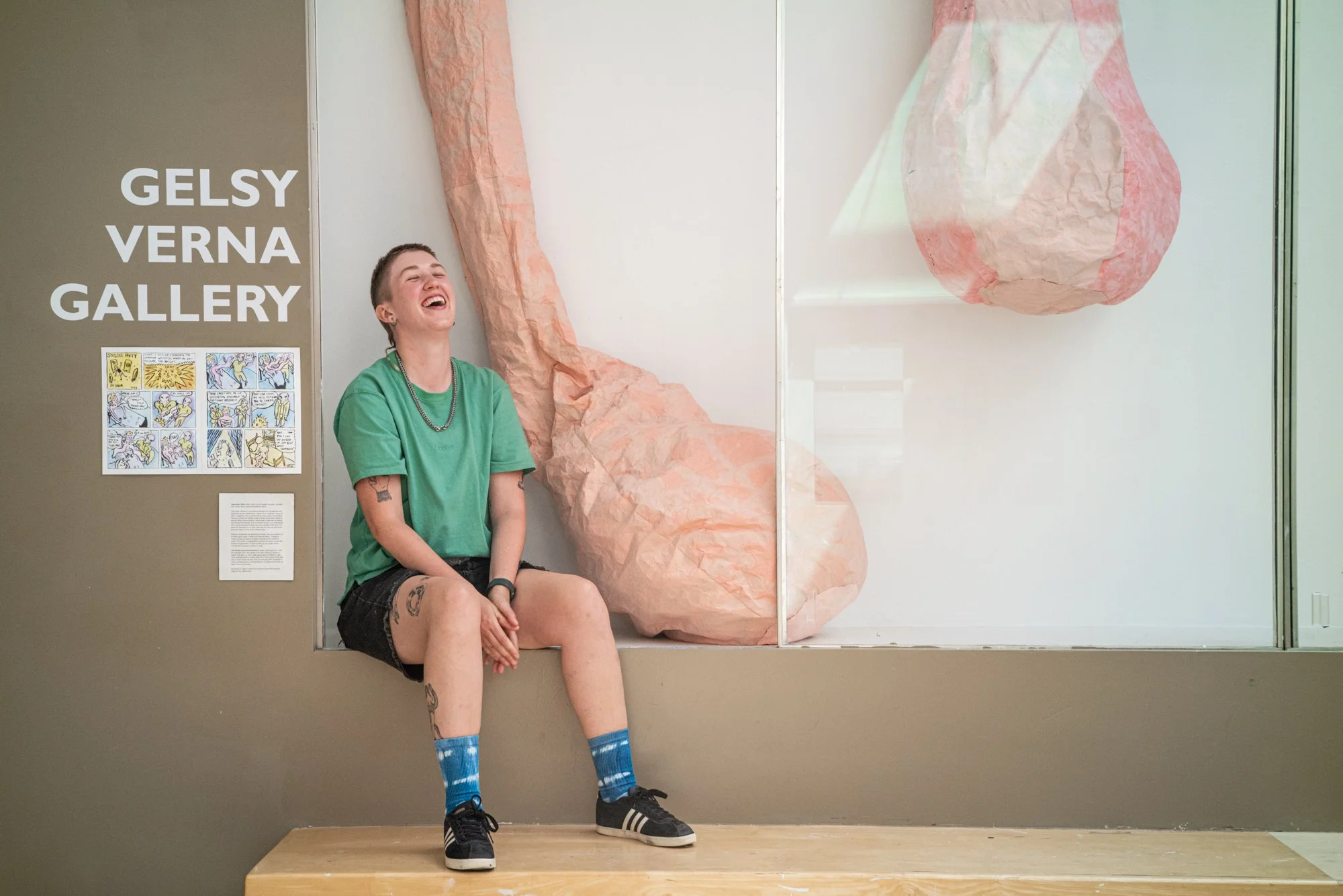
My work investigates the concept of home in both the grand vision of home, “who are we and where do we come from?” as well as smaller, personal questions of “what do I keep close to my home?”. Home is made with the objects we chose to populate our spaces, the clothes we put on our body, and with the direct decisions we make to connect with the land we live on and our genealogy. These questions of home have propelled me to create large scale sculptures and smaller embroidery and lace works.
My material research bridges a crafted binary by examining how nets have been gendered over time, how net structures became foundational to lace-making, and how my practice can resist gendered expectations through form and application. My experience with these processes developed through sustained engagement with embroidery, lace-making, and net construction.
My interest in subverting craft conventions began early in my textile practice through embroidery. Initially, I embroidered underwear—appropriating a traditionally “feminine” skill and applying it to utilitarian Hanes briefs. This impulse to challenge artistic and cultural expectations has since expanded to nets as both material and conceptual structures. I now work with knotting, tatting, and rope-based net-making techniques to produce nets that are monumental in scale and material, yet decorative in intent. By positioning large rope nets within gallery spaces, I challenge assumptions that such objects must serve functional purposes.
My entry point into netting is lace. Lace-making introduced me to repetitive, structural processes that parallel net construction. After beginning my gender transition in 2022, I became increasingly aware of the tension between my masculine-presenting exterior and my continued engagement with feminized craft practices. Working with heavy-duty rope to tat lace-like forms onto knotted net structures allows me to merge these traditions materially.
Through the physical demands of large-scale net-making, I access forms of labor and masculinity that lace does not permit. Nets, like my experience as a trans non-binary person, complicate rigid binaries and occupy a liminal space between textile and tool, labor and decoration, structure and softness.